



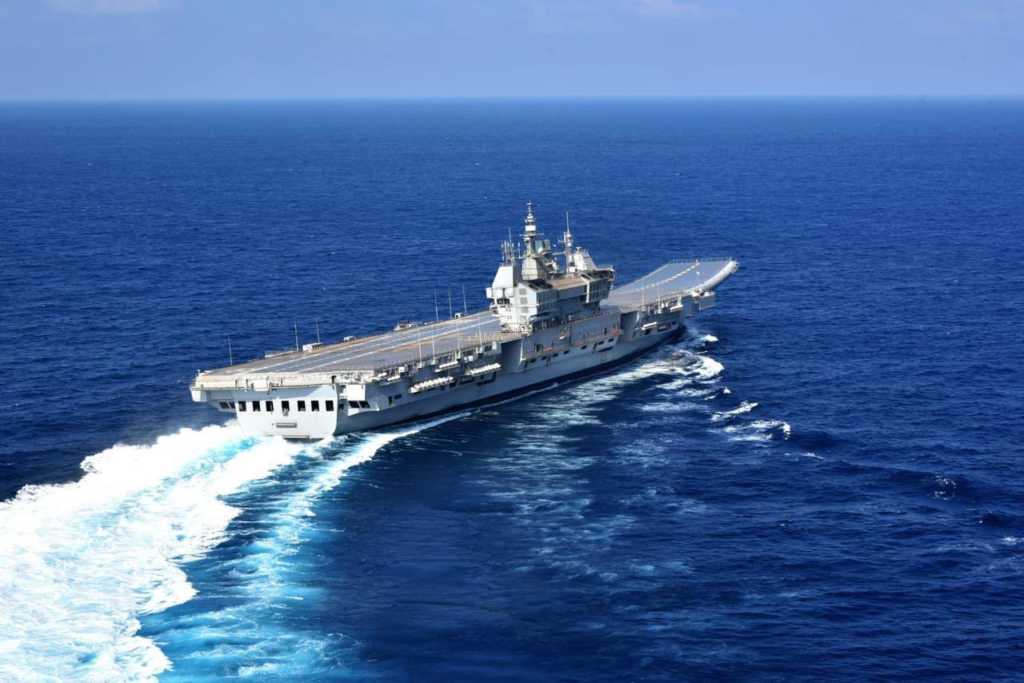
Karachi Port attack: Amid escalating tensions between India and Pakistan, the Indian Armed Forces have moved into a heightened state of readiness along the border and at sea. The Indian Navy’s flagship aircraft carrier, INS Vikrant, has been deployed to the Arabian Sea, serving as a powerful deterrent and a command center for naval operations. While there were rumors that INS Vikrant had launched strikes on Karachi port, there has been no official confirmation of such an attack. Instead, the warship remains on high alert, prepared to respond decisively to any hostile move from Pakistan.
INS Vikrant: India’s Maritime Powerhouse
Commissioned in 2022, INS Vikrant is India’s largest and most advanced aircraft carrier. With the ability to operate independently for up to 45 days, it functions as a floating airbase, equipped with state-of-the-art weaponry, including Barak-8 and BrahMos missiles, naval guns, and advanced fighter jets. The carrier is designed to project power across the Indian Ocean, offering both offensive and defensive capabilities that far exceed those of Pakistan’s navy.
In the present situation, the deployment of INS Vikrant in the Arabian Sea demonstrates India’s willingness to safeguard its maritime boundaries and address any potential escalation. Although some media outlets reported that the carrier may have participated in strikes on Karachi, official sources have not confirmed such actions.
Karachi Port attack: Rising Tensions and Blackouts Across Border States
The situation along the India-Pakistan border has become increasingly volatile following India’s Operation Sindoor, a precision strike mission targeting nine terror camps in Pakistan and Pakistan-occupied Jammu and Kashmir (PoJK). This operation was launched in retaliation for the April 22 terror attack in Pahalgam, Jammu & Kashmir, which killed 26 people.
In response, Pakistan attempted to retaliate by firing a barrage of missiles and deploying drones against Indian military installations in Jammu, Punjab, and Rajasthan. Indian air defense systems, such as the S-400 Sudarshan Chakra, effectively neutralized all incoming threats, averting any major damage or loss of life.
Explosions and flashes lit up the night sky in cities like Jaisalmer and Bikaner, where residents reported hearing loud blasts as Indian forces neutralized incoming drones and missiles. The intensity of the attacks prompted authorities to enforce complete blackouts in several border districts-Bikaner, Jaisalmer, Barmer, Sriganganagar, and Jodhpur in Rajasthan; Gurdaspur, Jalandhar, Amritsar in Punjab; and key locations in Jammu & Kashmir.
During these blackouts, all non-essential lights were turned off, and residents were instructed to stay indoors to minimize the risk of being targeted. Sirens signaled the start and end of blackout periods, and authorities warned that violations could result in legal action.
Karachi Port attack: Emergency Measures and Civilian Safety
The government has implemented a range of emergency protocols to protect civilians and critical infrastructure:
– Nightly blackouts: Enforced from 9 pm to 5 am in sensitive districts, with exceptions for hospitals and jails (which must still cover windows to prevent light leakage).
– Curfews and restrictions: Pakistan is said to have enacted curfews in various areas and implemented a countrywide lockdown in response to India’s missile attacks.
– Red alerts and sirens: Authorities in Rajasthan and Punjab have issued red alerts, using sirens to warn residents and coordinate emergency responses. Additional police, disaster response teams, and medical units have been deployed to border districts.
– Shoot-at-sight orders: The Border Security Force (BSF) has been authorized to use maximum force to prevent any unauthorized movement along the border.
Missile and Drone Attacks: India’s Response
On Thursday night, Pakistan fired eight missiles at Indian targets in Satwari, Samba, RS Pura, and Arnia, all of which were intercepted by India’s air defense units. Similar attacks were attempted in Bikaner, Jaisalmer, and other locations, but Indian forces neutralized all incoming threats.
Indian air defenses also intercepted Pakistani drones over Udhampur in Jammu & Kashmir and Jaisalmer in Rajasthan, with residents reporting explosions and flashes in the sky as the drones were destroyed.
Impact on Civilian Life
The escalation has deeply affected daily life in border areas:
– Widespread blackouts: Cities and towns near the border have experienced repeated power cuts and blackout orders, disrupting normal routines and causing anxiety among residents.
– Curfews and lockdowns: Pakistan reportedly imposed curfews in several regions and a nationwide lockdown following India’s missile strikes.
– Emergency relief: State governments have allocated emergency funds and deployed extra security and medical teams to assist affected populations.
– Transport and flights: Several airports in northern and western India have been closed or are operating under emergency protocols, with flights canceled or diverted due to the security situation.
Conflicting Claims and Official Statements
While Indian media reported significant damage to Karachi port and other sites in Pakistan, Pakistani authorities initially denied any such incidents. However, the Karachi Port Trust later acknowledged “significant damage” from Indian strikes and stated that emergency response efforts were underway.
Pakistan’s Foreign Office dismissed Indian claims of cross-border attacks as “baseless propaganda,” accusing India of trying to justify aggression and destabilize the region. Pakistan called on the international community to urge restraint and prevent further escalation.
INS Vikrant’s Strategic Role
INS Vikrant’s deployment underscores India’s naval strength and readiness to counter any maritime threats. The carrier’s ability to launch multiple fighter jets, operate for extended periods without resupply, and deliver precision strikes makes it a formidable asset in the region.
Pakistan’s navy, by comparison, lacks similar capabilities, with no aircraft carriers and limited submarine strength. This imbalance gives India a significant advantage at sea, should the conflict escalate further.
Government and Military Coordination
India’s central and state governments have held high-level meetings to assess the situation and coordinate emergency measures. Rajasthan’s Chief Minister has allocated special funds for border districts, canceled all government staff leave, and ordered daily reviews of the security situation.
Police and security forces have intensified patrolling, banned drone activity in border areas, and warned residents to comply strictly with blackout and curfew orders.
A Region on Edge
The current standoff between India and Pakistan has pushed both nations into a state of heightened alert, with the risk of further escalation remaining high. India’s armed forces, backed by advanced technology and robust emergency measures, have so far successfully defended against multiple missile and drone attacks.
INS Vikrant’s presence in the Arabian Sea stands as a powerful deterrent, signaling India’s readiness to defend its interests at sea and on land. While rumors of strikes on Karachi port persist, official confirmation remains pending. Meanwhile, both countries continue to brace for further developments, with civilians and security forces alike adapting to a rapidly changing and unpredictable security landscape.
As the situation evolves, the priority remains the safety of civilians, the protection of critical infrastructure, and the maintenance of national security. The coming days will be crucial in determining whether tensions subside or escalate into a broader conflict.
MUST READ: Explosions Rock Jaisalmer: Pakistan Missile Attack Triggers Blackout in Rajasthan