


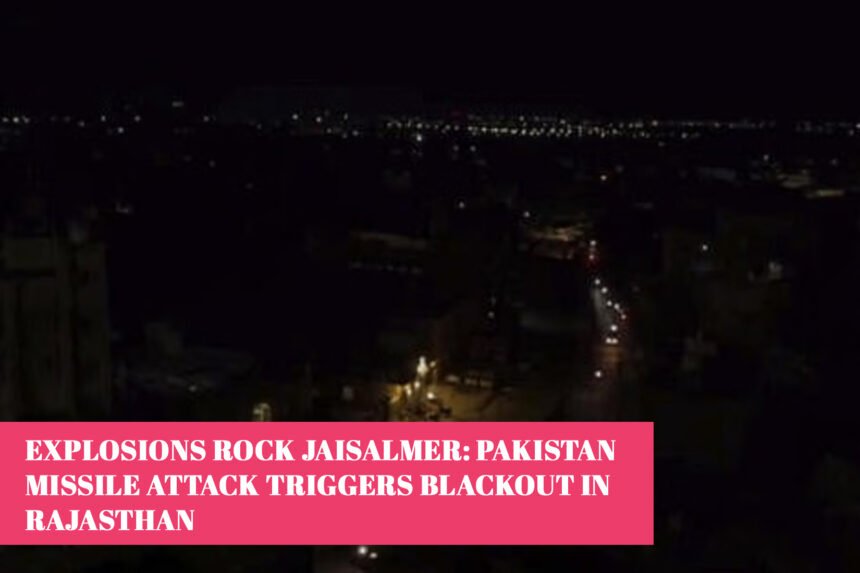
Explosions Rock Jaisalmer: On Thursday evening, the situation between India and Pakistan escalated significantly as air raid alarms sounded throughout cities in Punjab, Rajasthan, and Jammu and Kashmir, alerting citizens to the approaching threat. Authorities ordered complete blackouts in these regions to shield both civilian and military sites from possible attacks. The precaution came after Pakistan launched a coordinated assault using missiles and drones, aiming at Indian military targets in border states.
In Jaisalmer, Rajasthan, residents reported hearing a series of loud explosions. Local officials described a “massive sound” that was followed by a brief silence, then more blasts that continued for about an hour. The attack was part of a larger offensive, with Pakistani forces firing at least eight missiles at targets in Jammu and Kashmir alone. Indian air defense units, equipped with advanced systems like the S-400, successfully intercepted all incoming missiles in this region, preventing any reported casualties or damage.
The town of Pathankot in Punjab, situated near the Pakistan border and acting as an entry point to Jammu and Kashmir, was enveloped in darkness, along with Chandigarh and various other cities. Footage and pictures posted by locals displayed missiles soaring through the night sky, intercepted in-flight by Indian defense systems, with blasts illuminating the darkness.
During this wave of attacks, Indian forces managed to shoot down at least one Pakistani F-16 fighter jet. This was not the first such incident in recent days; since Wednesday, Pakistan had attempted to strike military installations in at least 15 Indian cities, including Jalandhar, Srinagar, Amritsar, and Ludhiana.

India also launched countermeasures. Israeli-made HARPY drones were used to destroy Pakistani air defense systems in Lahore and other locations, leaving them exposed to further counterattacks. The Indian military’s response was described as both “kinetic and non-kinetic,” meaning it involved both physical strikes and electronic warfare tactics. Officials confirmed that all threats were neutralized and no major casualties or material losses were reported on the Indian side.
MUST READ: Impact of Pahalgam Terror Attack: West Bengal Tourists Choose Shimla and Ooty Over Kashmir
These attacks came just a day after India’s armed forces carried out Operation Sindoor series of precision strikes on four terrorist camps in Pakistan and five in Pakistan-occupied Kashmir (PoK). The operation, which lasted about 25 minutes in the early hours of Wednesday, involved a barrage of 24 smart munitions, including HAMMER bombs and SCALP missiles. According to Defence Minister Rajnath Singh, over 100 terrorists were killed in these strikes, which targeted the headquarters and training camps of groups like Lashkar-e-Taiba and Jaish-e-Mohammed.
Operation Sindoor was India’s direct response to the April 22 terror attack in Pahalgam, Jammu & Kashmir, where four terrorists from The Resistance Front- a Lashkar-e-Taiba proxy- killed 26 people, many of whom were tourists. Prime Minister Narendra Modi had promised a strong response, and the strikes were carried out to be precise and non-escalatory, focusing only on terrorist infrastructure and avoiding civilian or military targets.
Due to the intensifying conflict, power outages and curfews were enforced in border regions, and security measures were increased at airports in cities such as Amritsar, Jammu, and Chandigarh. Officials in Chandigarh and nearby areas in Haryana also advised residents to switch off their lights and remain indoors during the night as a safety measure. Power was cut across the Kashmir valley, and emergency services were put on high alert.
The Indian government held an all-party meeting to brief political leaders on the situation, with opposition parties expressing support for the military’s actions and the armed forces’ efforts to protect the nation. Defence Minister Rajnath Singh emphasized that India’s objective was not to escalate the conflict but to ensure national security, and he warned that any further aggression from Pakistan would be met with a strong response.

Meanwhile, Pakistan’s attacks included the use of drones and missiles, some of which targeted civilian airports and public areas. Indian forces reported shooting down multiple Pakistani jets, including an advanced AWACS surveillance aircraft, further weakening Pakistan’s ability to coordinate its air operations.
Despite the intense exchanges, Indian officials reiterated that their actions were measured and aimed solely at dismantling terror networks responsible for attacks on Indian soil.
The past 48 hours have seen a dramatic increase in hostilities between India and Pakistan, with both sides using advanced military technology and tactics. While India’s Operation Sindoor dealt a significant blow to terrorist infrastructure, Pakistan’s retaliatory strikes have led to heightened security, blackouts, and widespread concern among civilians in border areas. The Indian government continues to monitor the situation closely, emphasizing its commitment to national security and readiness to respond to any further threats.