

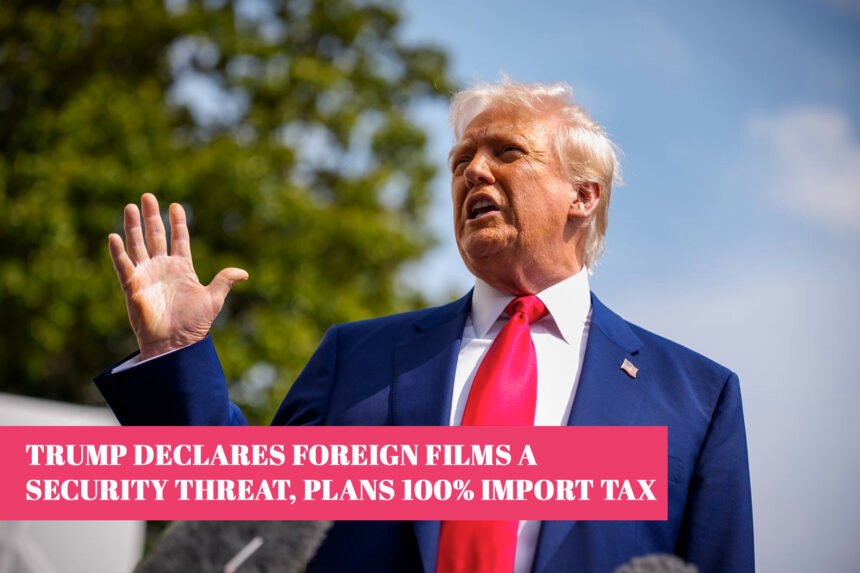
Former President Donald Trump announced on Sunday his intention to implement a 100% import tax on films made outside the United States, marking the first time his strict trade policies will affect the entertainment industry.
In a message on Truth Social, Trump stated that he is instructing the Commerce Department and his trade representative to start applying this tax on foreign films. He stressed, “We want to see movies produced in America once more!”
Additionally, Donald Trump described foreign films as a potential national security risk, claiming that other countries use movies for propaganda and messaging.
This statement came after Trump’s discussion with performer Jon Voight and his agent, Steven Paul, at his Mar-a-Lago estate over the weekend. Sources familiar with the meeting, who wished to remain anonymous, confirmed their visit.
Voight and Paul talked about their suggestions for enhancing federal tax incentives to promote increased film and television production in the United States. Their suggestions focused on expanding current tax credits and bringing back previous incentives to help attract more projects and jobs to the U.S. Their suggestions included expanding current tax credits and reinstating expired ones. Although they did not propose tariffs, Trump brought up the idea during their discussions, but no specific details were provided.
In January, Donald Trump named Voight, Mel Gibson, and Sylvester Stallone as special representatives for Hollywood to assist in generating more employment opportunities in the U.S. film sector.
It is still uncertain how this 100% Import Tax will be applied or how movies will be evaluated for tax reasons. Many Hollywood films include international partnerships, with shooting taking place in other countries and post-production work happening around the world. Questions also arise about whether the tariff would apply to films that have already been completed but not yet released, or only to new projects.

Upcoming films located in different nations feature Walt Disney’s The Fantastic Four: First Steps, which was recorded in the United Kingdom and Spain, along with Universal Pictures’ Jurassic World Rebirth, recorded in Thailand, the United Kingdom, Malta, and America.
This action comes after China decided to “slightly cut back” on the number of Hollywood movies permitted in the country in reaction to Trump’s tough tariffs on U.S. goods. The China Film Administration mentioned that these limits could lead to a decline in the local audience’s preference for American films.
While the U.S. film industry is the most powerful globally, foreign films have gained popularity in recent years, receiving critical acclaim. For instance, the South Korean movie Parasite received four Academy Awards, including the award for Best Picture, in 2020.
The Motion Picture Association indicates that the cinema and television sector generated approximately 2.3 million positions in the United States. The association did not respond to inquiries about Trump’s proposed tariffs outside of regular business hours.
In the past few years, cinema and television creation in the United States has declined for various reasons. Media companies have reduced spending to increase profits while transitioning from traditional television to streaming services, which are expanding internationally and producing more content for foreign audiences.
Research from ProdPro shows that spending on film and TV production in the U.S. fell by 28% from 2021 to 2024. Meanwhile, countries like Canada, Australia, and the UK are seeing an increase in film and TV production, partly because of appealing tax benefits and lower costs for making films.
Filming in the larger Los Angeles area dropped by 22% in the first three months of the year, showing that California is still losing business to other places.
MUST READ: 2025 Financial Year Kickoff: New Rules for Taxpayers and Investors